
hop right off the launch roller coaster
Join the
evergreen edge academy
You’ve created a membership site that’s making a real impact and your members love. And while the launch marketing model has helped you get this far, it’s just not working as well for you anymore.
It’s time to go evergreen!
Why go evergreen?
An evergreen marketing funnel lets you scale faster and launch less frequently. Unlike open memberships where anyone can join anytime, evergreen let’s you continuously enroll people who are truly interested to your membership without having to wait for a launch.
Scale Further
When you lose as many members between launches as you gain during launches– that’s the dreaded “launch plateau”. Your membership goes sideways. Evergreen breaks through the launch plateau so you can achieve the growth you want.
Love on Your Members
Evergreen runs itself, so you can get off the sales hamster wheel. You’ll spend less time planning and running launches and more time serving your members.
Reduce Reliance on Launches
Events beyond our control can throw a wrench into the best planned launches. Launching can feel super stressful when you have all your eggs in this one basket.
Iterate and Optimize Much Faster
With an evergreen funnel, you get constant feedback on what is converting for your audience. So you can easily adjust your ad budgets, content, and designs to get the most out of your investment.
Create More Consistent Revenue
Even for seasoned membership owners, the best planned launches are still hard to predict. With evergreen, you’ll have a steady stream of data which tells you what to expect financially, helping you run your business more effectively.
Spend More Time On What You Love
Evergreen works even when you aren’t. Because your evergreen funnel is completely automated, you can take that vacation and still grow your membership and bottom line.
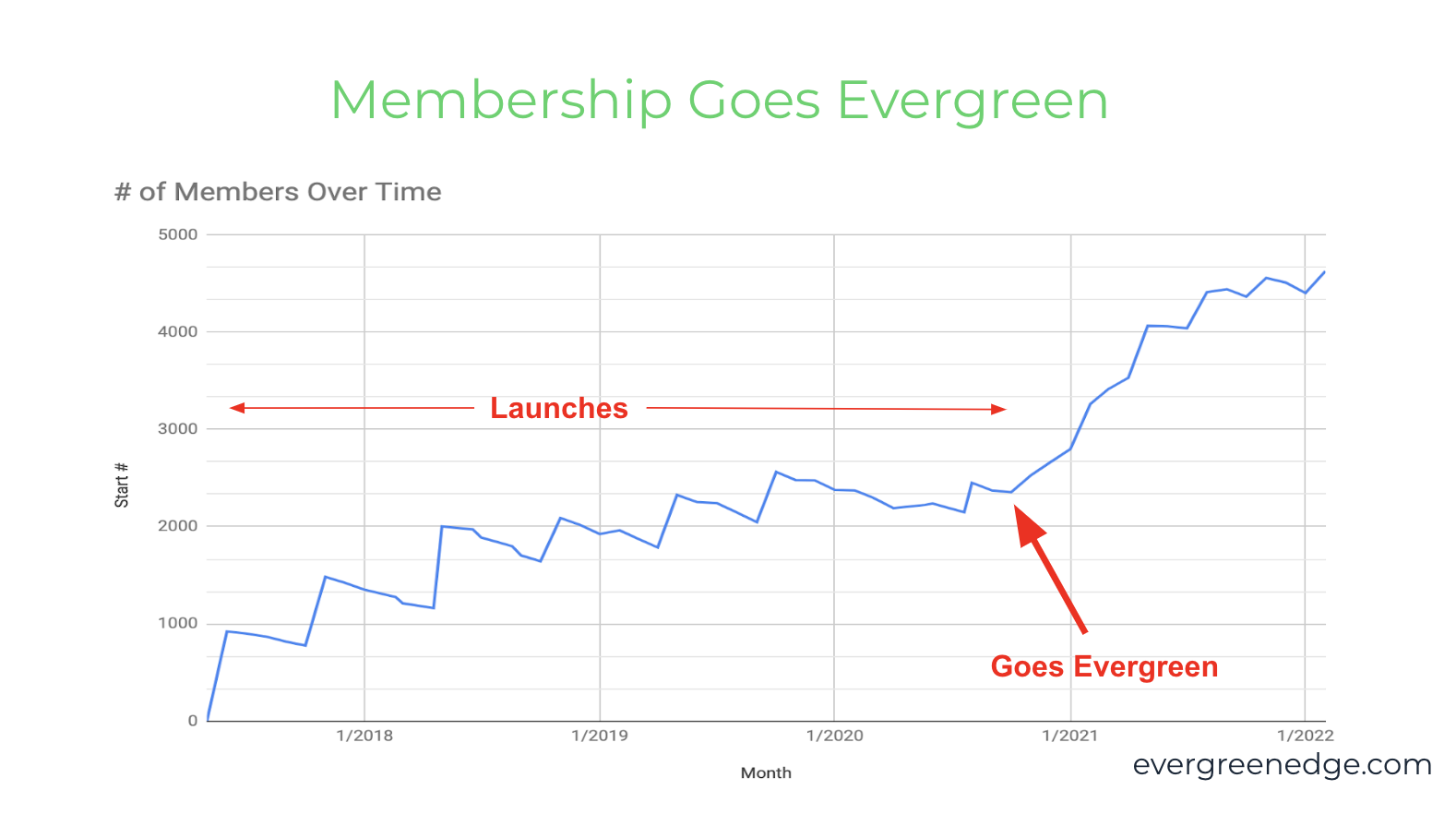
In this real membership example, launches led to strong initial growth (year 1). But then the membership hit a Launch Plateau because it got to a size where launch growth only replaced member attrition between launches. Then, in year 4, the membership went evergreen and began to scale again in a big way.
About the Academy
The Evergreen Edge Academy is where online membership owners and their teams get the training, coaching, resources, and support they need to build and scale a highly profitable evergreen webinar funnel.
Focused Trainings
Self-guided bite-sized lessons on how to go evergreen
Live Group Coaching
Regular office hours with Scott and other evergreen experts
Time Saving Templates
Swipe files, templates, checklists, and more
Systems & Tools
Gets you up and running fast – even if you’re not techie
Community Support
Celebrate wins, get advice, and learn from others’ efforts
what you will learn
01
Going Evergreen: The Math, The Funnel, The Process
Learn what success looks like, the elements of the funnel, how to know if it’s working or not, and what you can expect in terms of your effort level and realistic profitability.


02
The Secrets to a High-Converting Evergreen Webinar or Workshop
Your webinar is the key to a profitable evergreen funnel. Learn the nuances of how to structure a high-converting webinar or workshop and how to effectively and comfortably sell your membership.
03
Transitioning to Evergreen
An evergreen funnel can bring in hundreds or thousands of new members on auto-pilot. But first you have to build out and automate your entire funnel, step-by-step, the right way.


04
Scalable Evergreen Ad Strategy
Ad costs have gone up. You’ll learn how to devise a digital ad “Test Lab” that drives a low enough Cost Per Acquisition to make all of this work for your membership regardless of rising ad costs.
05
Evergreen Analytics
You’ll see how to set up an automated tracking system that gives you all the numbers you need to make effective strategic decisions about optimizing your funnel.


06
The Member Multiplier
This is the secret sauce that takes your evergreen funnel from “effective” to “outstanding”. You’ll learn exactly what to do with leads who don’t immediately buy.
Going Evergreen opens the door to
thousands of new members
JOIN NOW
- Focused trainings that show you step-by-step in bite-sized chunks how to create everything for your evergreen funnel
- Time-saving templates that you can adapt for your own use
- Support from experts and peers in the Evergreen Edge community
- Systems and tools to make tracking your metrics easy (even if you hate math)
- Regular live office hours with Scott and other evergreen experts
If you add just 5 new monthly members as a result of joining the Academy, it pays for itself.*
* Assumes your membership costs $47 per month with a 95% retention rate.
Plus, BONUSES!
- BONUS: A Guide to Evergreen Onboarding
- BONUS: Scott’s Evergreen Tracking Spreadsheet
- BONUS: Advanced Evergreen Calculator
We will be with you the whole way – training, coaching, supporting, and providing the resources you need to successfully take your membership evergreen.
Get in touch if you have any questions!
What They’re Saying
“Working with Scott, we more than doubled our investment in less than a year! The power of evergreen is phenomenal!”
“When it comes to all things evergreen, Scott is my go-to guy. In fact, Scott was the first person I thought of to present an evergreen bonus for The Membership Experience and his team has been great to partner with.”
“Your knowledge and expertise on this topic is world class and you have an awesome program. Knowing my numbers… the calculator has given me the confidence to scale my business.”
“The Academy has been highly valuable and super clear on what needs to happen and get done to make evergreen a success! I was really happy with everything I’ve learned and taken away from the Academy. Definitely worth the investment for sure. 💪❤️”
“I’m totally grateful for this opportunity – I wouldn’t have evergreen launched if you hadn’t offered this program.“
“We had been stuck around 800 members for a while and this program helped us get to 2,500 members in just 5 months. I can’t believe how fast we grew!”
Hi, I’m Scott Paley
For more than 20 years, I’ve helped hundreds of organizations grow through strategic, creative digital marketing – from big brands like Clairol and Marriott to nonprofits like the Innocence Project and Million Mom March to individual experts like Joan Garry and Carrie Green.
In 2017, I co-founded a very successful membership site that serves nonprofit leaders – the Nonprofit Leadership Lab – which in three years, grew to 2,000 members using the launch model.
But then we hit the “launch plateau”.
When you lose as many members between launches as you gain during launches– that’s the launch plateau. At some point, this happens to every membership – even those with really high retention rates.
Our membership was stagnating even though I knew there was still a ton of room to grow in the market.
That’s when we went evergreen. And it worked!
In less than a year we went from our consistent 2,000 members to more than 4,500 members. We grew fast and with a lot less stress! We were able to help so many more people and organizations and the ripple effect has been enormous.
Now I help others achieve evergreen success.
- I build and maintain evergreen funnels for membership owners through my agency Abstract Edge.
- I train and support teams to go evergreen through the Evergreen Edge Academy.
Me, beyond evergreen…
Besides my work life, I love to travel, read, play piano, sing, and watch the amazin’ New York Mets. Though born and raised in the New York City suburbs, in 2008, I took my business 100% remote and moved with my wife, Sharon, and our two children to Baltimore, Maryland.

Let’s Grow Your Membership Together
No matter what kind of membership you run, you could be serving a lot more people than you currently are.
If you want to launch less often…
If you want more time to love on your members…
If you want to take a vacation without sacrificing your sales…
If you want fewer peaks and valleys in income and more reliably consistent revenue…
If you want your launches to more than just refill your churn…
If you want more time and ability to nail down your ad campaigns…
The Evergreen Edge Academy is how you’ll get there.